
Roller door spring repair in Melbourne is the single most common emergency service call for roller door systems across the city, and for good reason. The spring in a roller door system is the component that does the most mechanical work — it stores energy when the door closes and releases it when the door opens, counterbalancing the door’s full weight with every operating cycle. Without the spring functioning correctly, the door cannot operate safely or at all. Roller door spring repair in Melbourne addresses what the spring does, why it fails, what the failure looks and sounds like, and how the repair is correctly and safely performed — because spring repair is specifically not a safe DIY task, regardless of how mechanically capable the homeowner might be in other areas.
What the roller door spring actually does
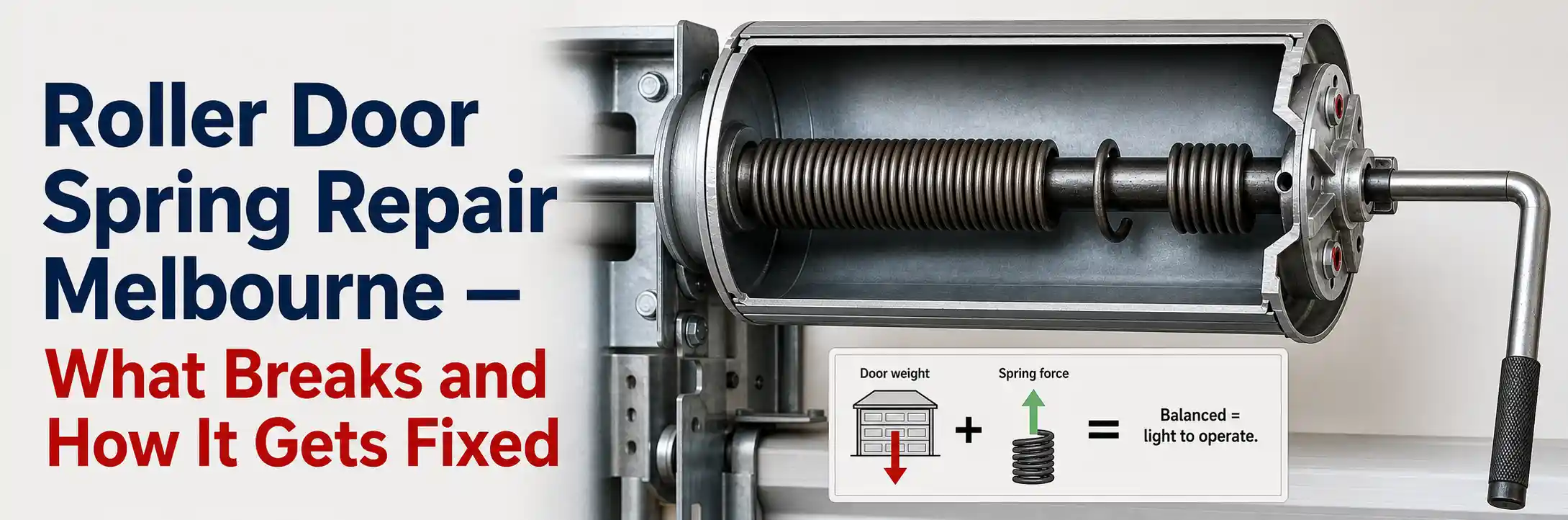
The spring in a roller door system sits inside the drum — the cylindrical housing that the door curtain coils onto above the opening. A correctly tensioned spring counterbalances the weight of the door curtain so that the net force required to lift or lower the door is approximately zero.
When the door is correctly balanced, it should be possible to lift it to any height, release it, and have it stay in position. The automatic opener motor operates the door without significant effort because the spring, not the motor, carries the door’s weight.
The spring stores and releases energy through winding and unwinding. As the door closes and the curtain uncoils from the drum, the spring winds tighter, storing energy. As the door opens and the curtain coils back onto the drum, the spring unwinds, releasing the stored energy that lifts the curtain. This winding cycle happens with every door operation, and the spring is therefore under continuous stress throughout the door’s service life, even when the door is stationary in the closed position.
Why roller door springs fail in Melbourne homes
Roller door spring repair in Melbourne is prompted by spring failure that typically falls into one of three categories:
- Cycle life exhaustion — residential roller door springs are rated at a number of operating cycles, most commonly 10,000 for standard springs and 20,000 to 30,000 for high-cycle alternatives. At two door operations per day, a 10,000-cycle spring has a theoretical service life of 13 to 14 years. In a busy family household where the garage is the primary entry and exit point and the door cycles four to six times daily, a 10,000-cycle spring reaches its limit in 4 to 7 years. Melbourne households with the garage door as their primary daily access point will cycle through standard springs significantly faster than the theoretical 13-year life suggests.
- Corrosion and environmental degradation — Melbourne’s diverse climate creates suburb-specific corrosion conditions. In bayside suburbs like Albert Park, Brighton, and Sandringham, Port Phillip Bay salt air accelerates spring corrosion and brings forward the failure point. In any Melbourne suburb, a spring that has never been lubricated will develop surface rust from moisture exposure that weakens the effective metal cross-section and causes early failure. The spring’s constant tension concentrates stress at any surface defect created by corrosion.
- Incorrect specification from a previous installation — a spring installed at a previous service that was not correctly matched to the door’s weight and travel will be operating at a tension level either above or below what it was designed for. A spring that is under more tension than its specification was rated for reaches its cycle limit faster and is more susceptible to sudden failure.
The sound and symptoms of roller door spring failure
Roller door spring repair in Melbourne is most commonly prompted by one of these presentations:
- The loud bang — a spring that fails under full tension releases its stored energy in a fraction of a second, creating a sharp crack or bang that is often heard throughout the home. This is the most common way Melbourne homeowners discover their spring has failed — the sound from the garage, followed by a door that will not open when they try it.
- The door that suddenly feels very heavy — for a spring that has lost significant tension gradually rather than failing suddenly, the first sign is a door that feels increasingly heavy when operated manually. The automatic opener begins to strain. The door moves slowly. Eventually the opener’s safety cutout disconnects the motor.
- The door that stops mid-travel — a spring at the very end of its service life may allow the door to open partially before the available spring tension is exhausted, leaving the door stopped at a point in the travel where neither the spring nor the motor can complete the cycle.
- A visible gap in the spring coil — on inspection of the spring inside the drum, a clear separation in the coil confirms the spring has snapped. This is sometimes visible from the garage floor without having to access the mechanism directly.
Why roller door spring repair is not a DIY task
Roller door spring repair in Melbourne must be performed by a qualified technician, and this is not a conservative professional recommendation — it is a genuine safety imperative. The spring inside a roller door drum is wound to a tension that corresponds to the full weight of the door curtain. For a standard residential roller door, this means the spring stores energy equivalent to the force required to lift 40 to 80 kilograms. When a spring fails, this energy releases instantly.
Attempting to release the tension from a loaded spring without the correct winding bars and the specific experience of performing this operation safely creates a risk of the spring releasing its stored energy in an uncontrolled manner.
The tools required for safe roller door spring repair in Melbourne include specific winding bars that engage the winding cone on the spring shaft — not standard bar stock or improvised tools. The winding procedure requires controlled, incremental release of tension with the technician positioned to the side of the winding cone rather than in the plane of its potential release arc. A technician who performs this procedure regularly has developed the specific muscle memory and situational awareness that makes it safe. A homeowner attempting it for the first time, with improvised tools, does not.
What the roller door spring repair visit involves
Roller door spring repair in Melbourne by a qualified technician covers:
- Safe release of any remaining tension in the failed spring and any intact spring sharing the shaft, using the correct winding bars and controlled release procedure.
- Removal of the failed spring and measurement of the replacement specification — wire diameter, coil diameter, length, and wind direction must match the door’s weight and the counterbalancing geometry precisely.
- Installation of the replacement spring and winding to the correct tension for the specific door. The tension is calibrated so the door holds stationary at the midpoint of its travel when manually lifted and released — the standard balance test.
- Assessment of both springs if the door has a two-spring system — replacement of both in the same visit is strongly recommended when one has failed, as the second spring has the same cycle history.
- Full operational test of the door and automatic opener, including adjustment of the opener’s force settings if the new spring has changed the door’s operating weight profile.
- Lubrication of the new spring and all other moving components accessible during the visit.
Specifying the right replacement spring for Melbourne
Roller door spring repair in Melbourne should use a replacement specification appropriate to both the door’s weight and the suburb’s environment. For bayside Melbourne properties, a galvanised or powder-coated spring provides corrosion resistance appropriate for the salt air environment. For all Melbourne properties, a high-cycle spring rated at 20,000 or 30,000 cycles is a sound upgrade from a standard 10,000-cycle spring, particularly for households where the door cycles more frequently than twice daily.
The spring replacement visit is also the appropriate moment to discuss the full system condition with the attending technician. A technician who has been inside the drum mechanism to replace the spring has had a closer look at the curtain coil, the drum surface, and the shaft condition than any external inspection provides.
If the technician notes anything about these components during the spring replacement — a drum that is no longer perfectly round, a curtain that is coiling unevenly, a shaft that shows corrosion — these observations are worth recording as items to monitor at the next service. The roller door spring replacement visit, approached as a system condition assessment as well as a spring repair, extracts the maximum value from the technician’s attendance and gives the homeowner a more complete picture of the door’s remaining service life than a simple spring-and-go approach provides.
Conclusion
Roller door spring repair in Melbourne is a same-day emergency repair for the single most common failure point in a roller door system. The spring’s failure — sudden or gradual — makes the door inoperable and should prompt an immediate call to a qualified technician rather than any attempt to operate the door or service the spring independently.
The correct replacement specification, the simultaneous replacement of both springs in a two-spring system, and the calibration of the replacement spring to the correct tension for the specific door weight are the three elements of a spring repair that produces a reliable long-term outcome in Melbourne’s variable residential environment.