
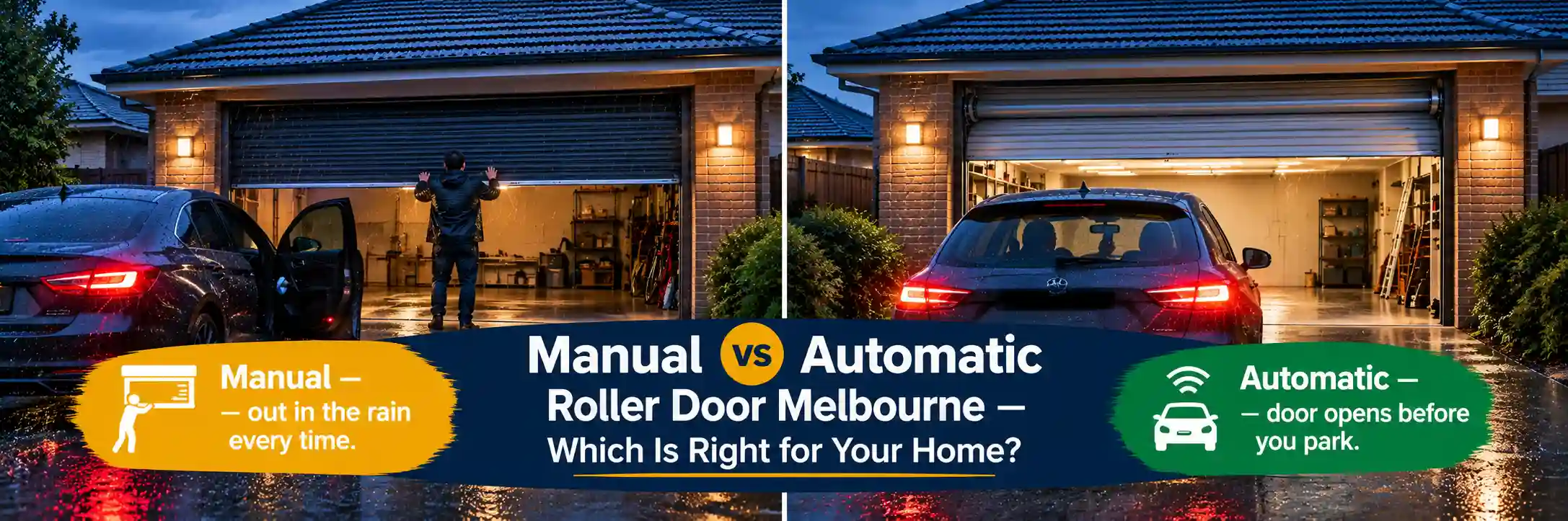
Manual vs automatic roller door in Melbourne is a decision that more homeowners are making with each passing year as automatic roller door technology has become more accessible, more reliable, and more integrated with the smart home systems that Melbourne households increasingly use.
For a Melbourne homeowner replacing a manual roller door or installing a new door on a garage conversion, the choice between a manual operation and an automated system is not simply a matter of convenience — it involves an assessment of the household’s daily use pattern, the security implications of the two systems, the maintenance requirements of each, and the specific features of current-generation automatic roller door openers that may not have been available when the existing manual door was installed. Manual vs automatic roller door in Melbourne addresses all of these dimensions.
How a manual roller door works in Melbourne
A manual roller door in Melbourne operates without any electrical or motorised component — the curtain is raised and lowered by hand, with the spring counterbalancing the door’s weight to make the manual operation comfortable. A correctly tensioned manual roller door should be light to operate, lifting from the closed position with a modest upward pull and descending from the open position with a gentle downward pull. The spring does the counterbalancing work; the operator provides only the initiating force to start the curtain moving in the desired direction.
A manual roller door in Melbourne is secured in the closed position by a locking bar — a horizontal steel bar that runs across the inside face of the curtain and engages locking brackets on each side of the opening. The locking bar is operated from inside the garage by a handle or lever that rotates the bar into and out of the brackets. From the outside, a manual roller door that is locked offers no manual entry point without cutting through the curtain or the guide mechanism.
The operational simplicity of a manual roller door is its primary advantage: there are no electrical components to fail, no remote control to lose, no motor to replace, and no firmware to update. A well-maintained manual roller door with a healthy spring can operate reliably for decades without any component failure beyond the spring itself. For a Melbourne garage that is accessed infrequently — a storage garage used weekly rather than daily — a manual roller door is a practical choice that avoids the ongoing maintenance requirements of an automated system.
How an automatic roller door works in Melbourne
An automatic roller door in Melbourne adds a tubular motor inside the drum to the manual roller door’s mechanical foundation. The tubular motor — a cylindrical motor unit that sits inside the hollow drum shaft — drives the spring shaft and drum assembly to raise and lower the curtain on command from a remote control, a wall button, or a smartphone app. The manual operation remains available as a backup through the motor’s emergency release function, which disconnects the motor from the drum and allows the door to be operated manually in the event of a power failure or motor fault.
Automatic roller door systems in the current Australian market include:
- Remote control operation — the standard automation function. A handheld remote transmitter sends a coded signal to the receiver on the motor unit, triggering the open or close cycle. Most current systems use rolling code technology that changes the transmitted code with each operation, preventing code copying.
- Wall button operation — a hardwired button mounted inside the garage triggers the door from inside without the remote. Useful when the remote is not convenient or as a backup to the remote.
- Smartphone app and Wi-Fi connectivity — available on current-generation tubular motors from major Australian brands. The app allows the door to be operated, monitored, and set with time-based auto-close functions from anywhere with a phone signal.
- Keypad entry — a battery-powered keypad mounted beside the garage opening allows the door to be opened from outside using a code, without a remote. Useful for family members who regularly need access without a remote.
The daily use case comparison for Melbourne households
Manual vs automatic roller door in Melbourne is most practically resolved by the household’s daily use pattern:
- High-frequency daily use — a Melbourne household where the garage is the primary vehicle entry and exit point, used twice or more daily by one or more household members, benefits most directly from automation. The convenience of opening and closing the door from inside the vehicle, without leaving the car in Melbourne’s rain or summer heat, is a genuine daily quality-of-life benefit. Automation also eliminates the situation where a household member discovers on returning from the school run that the door was left open all day — the auto-close timer function closes it automatically after a set period.
- Security priority — a Melbourne household where security is the primary concern benefits from a modern automatic roller door’s rolling code remote system, which is significantly more secure against signal copying than older fixed-code systems. A manual roller door relies entirely on the physical locking bar, which is secure but does not allow remote monitoring or status confirmation.
- Infrequent use — a Melbourne garage used primarily for storage and accessed once or twice a week does not generate enough daily convenience benefit from automation to justify the additional installation cost and ongoing maintenance of the motor system. A manual door with a correctly tensioned spring is entirely practical for infrequent-use applications.
- Power reliability concern — for a Melbourne property in an area that experiences frequent power outages — during storms or bushfire events that affect the distribution network — the manual operation backup on an automatic door provides access during outages, but requires the homeowner to use the emergency release in the dark. A battery backup module on the motor unit resolves this and is available as an addition to most current-generation tubular motor systems.
Installation and ongoing maintenance comparison
Manual vs automatic roller door in Melbourne has a clear maintenance difference. A manual roller door requires annual spring inspection, guide rail cleaning, lubrication, and locking bar service — the standard mechanical maintenance. An automatic roller door requires all of the above plus the motor-specific checks: drive mechanism inspection, limit switch calibration, remote and receiver function, safety reversal test, and battery backup test if fitted. The automated system has more components, each of which represents an additional maintenance point and potential failure.
For Melbourne homeowners considering automation: the additional maintenance requirements of an automatic system are manageable with the annual or twice-yearly service visit described in the maintenance guide blog, and the convenience and security benefits of automation justify the additional maintenance for daily-use applications. The maintenance overhead becomes the dominant consideration only for infrequent-use garages where the automation’s convenience benefit is not being realised daily.
Retrofitting automation to an existing Melbourne manual roller door
Manual vs automatic roller door in Melbourne does not require a full door replacement to make the transition from manual to automated. Most standard residential roller doors in Melbourne can be retrofitted with a tubular motor system without replacing the curtain, drum, or guide rails. The motor is installed inside the existing drum, the drive bracket connects the motor to the shaft, and the control system — receiver, wall button, and remote — is added to the installation. The spring may need to be re-tensioned or replaced as part of the retrofit if it has aged to the point where its tension is no longer appropriate for the now-automated operation.
For Melbourne homeowners with a functioning manual roller door that they want to automate: a technician’s assessment of the existing door confirms whether the spring condition, drum size, and guide rail configuration are compatible with a tubular motor retrofit before any product is ordered. A compatible door in good condition is an excellent candidate for automation at a significantly lower total cost than a full door replacement.
The manual vs automatic roller door decision in Melbourne benefits from a conversation with a roller door specialist who works across the full range of Melbourne’s housing types and use patterns. A specialist who regularly installs and services both manual and automatic roller doors in Melbourne’s inner terrace suburbs, bayside coastal homes, and northern suburban family homes brings the breadth of comparison experience that a homeowner making this decision once for their specific property does not have.
The recommendation they provide — based on the specific door’s dimensions, the garage’s access configuration, the household’s daily pattern, and the suburb’s environmental conditions — is more reliably matched to the actual circumstances than any generic guide can be. The decision to automate a Melbourne roller door is a long-term one; approaching it with the right information and the right specialist advice produces an outcome that serves the household well for the door’s full service life.
Conclusion
Manual vs automatic roller door in Melbourne comes down to daily use frequency, security priority, and household lifestyle. For Melbourne households where the garage is the primary daily vehicle access point — which describes the majority of suburban Melbourne households outside the inner-city terrace suburbs — automatic roller door operation is the choice that delivers genuine daily convenience, better security through rolling code technology, and the smart connectivity features that Melbourne’s increasingly connected households value.
For infrequent-use garages and storage applications, a well-maintained manual roller door is a practical, lower-maintenance choice. The retrofit option that adds automation to an existing manual roller door is the most cost-effective path for Melbourne homeowners who want to make the transition without replacing the full door system.