
Roller door maintenance in Melbourne is the annual discipline that prevents the emergency repair calls that a neglected roller door system eventually produces. Melbourne’s climate — the famously variable four-seasons-in-one-day pattern, with cold wet winters, hot dry summers, and the extreme temperature swings that make the city’s weather a constant talking point — creates specific maintenance demands for roller door systems across the metropolitan area.
A roller door in Caulfield that has come through a 42-degree January heat wave and then been rained on through a cold July faces more environmental stress than an equivalent door in a more temperate climate. Roller door maintenance in Melbourne calibrated to the city’s actual seasonal pattern addresses the wear that Melbourne’s conditions create rather than the generic annual service that does not account for local conditions.
The best time for roller door maintenance in Melbourne
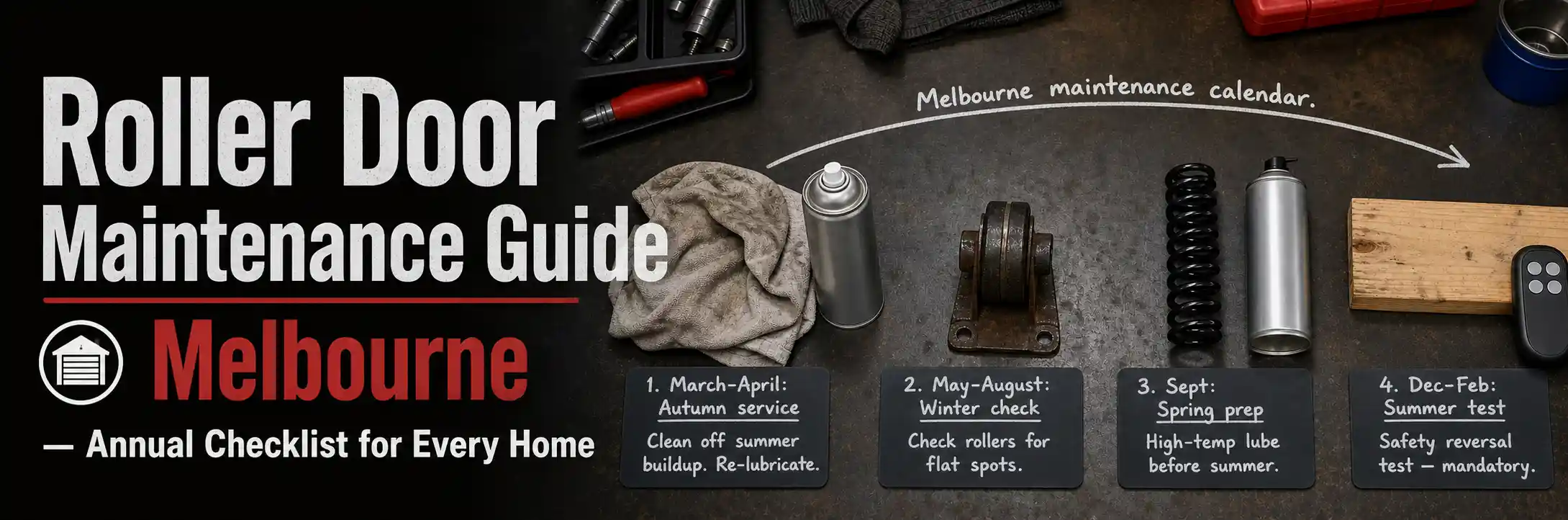
Roller door maintenance in Melbourne is most effectively timed to the early autumn transition — March to April — for two reasons. The first is that summer’s heat and dust accumulation has been at its maximum through January and February, and an autumn service addresses that accumulation before it becomes a winter problem when wet weather washes grit into mechanism gaps and creates an abrasive compound with the degraded summer lubricant.
The second is that spring’s tension behaviour is affected by temperature — a spring assessed and adjusted at moderate autumn temperatures is closer to its operating mid-range than one assessed at the extreme temperatures of midsummer or midwinter.
A secondary maintenance visit in spring — September to October — prepares the door for summer’s heat and higher use frequency. The spring inspection before summer catches any deterioration that developed during winter’s wet weather, and the re-lubrication with a heat-stable product prepares all moving parts for Melbourne’s summer temperature peaks.
The complete roller door maintenance checklist for Melbourne
Roller door maintenance in Melbourne covers the following components in a systematic sequence:
- Spring inspection — visually inspect the spring coils for rust, corrosion, deformation, or any visible gap that indicates cracking. Run a gloved finger along the coil surface to check for rough patches indicating developing rust. A spring with surface rust should be treated with a corrosion-inhibiting lubricant and monitored; a spring with significant rust patches through the coating is approaching a risk threshold and should be flagged for near-term replacement.
- Spring tension test — disconnect the automatic opener using the emergency release cord and manually lift the door to the halfway position. Release it. A correctly tensioned spring holds the door stationary at the midpoint. A door that slowly descends has a spring losing tension. A door that jumps upward has a spring that is slightly over-tensioned. Both conditions should be noted for the technician to adjust.
- Guide rail cleaning — the guide rails on each side of the opening accumulate dust, spider webs, insect debris, and in Melbourne’s outer suburbs, industrial dust and garden matter. Clean the full length of both rails with a dry cloth or brush before lubricating. Lubricating over accumulated debris traps it in the rails and creates an abrasive slurry rather than a protective film.
- Roller condition check — the nylon or steel roller wheels that run in the guides should be round and free-spinning. A roller that wobbles when spun, or that has a flat spot visible on the wheel surface, has worn past its useful service life. Worn rollers cause noise and binding and should be replaced during the maintenance visit.
- Lubrication sequence — use a dry PTFE lubricant or a product specifically marketed for garage door application. Apply to: the spring coils (light coating along the full length), the roller wheel bearings (not the wheel surface itself), the guide rails (a thin film to the inner running surface), the locking bar and its guides (along the full travel of the bar), and the drum shaft bearings if accessible. Do not use WD-40 as a lubricant — it is a water displacement product that leaves an oily residue that attracts dust and does not provide lasting lubrication.
- Locking mechanism function test — operate the locking bar manually through its full travel in both directions. It should move freely, engage cleanly, and release cleanly. A locking bar that requires force to move, or that does not engage completely, should be adjusted or the guide tracks cleaned and lubricated more thoroughly.
Automated roller door maintenance in Melbourne
Roller door maintenance in Melbourne for automated roller doors includes the mechanical checks above plus the automation system checks:
- Safety reversal test — place a solid object (a piece of timber 40 to 50 millimetres thick) flat on the ground under the door centre and trigger the close cycle. The door should contact the object, detect the resistance, and reverse automatically. If the door does not reverse on contact with the object, the safety reversal sensitivity is too low and must be adjusted before the door is used further. This is a non-negotiable safety test.
- Motor drive inspection — inspect the drive chain or belt for correct tension, wear, and lubrication. A chain that sags significantly between its support points should be tensioned. A belt that shows cracking or fraying should be replaced. Lubricate the chain lightly if it is dry; do not lubricate the belt drive.
- Limit switch check — confirm that the door travels to its full open and full closed positions before the motor stops. A door that stops short of the fully open position, or that does not close fully against the floor seal, has a limit setting that has drifted and needs adjustment.
- Remote control and receiver test — test the remote control from various positions within the driveway range. A remote whose range has decreased significantly may need a battery replacement, or the receiver antenna may have been damaged or displaced.
- Manual release function test — confirm that the emergency release cord disconnects the motor from the door as intended, and that the door can be operated manually after disconnection. A release cord that is frayed or whose connection to the trolley is worn should be replaced before it fails when needed.
Melbourne summer heat and roller door maintenance
Roller door maintenance in Melbourne has a specific summer preparation dimension. Melbourne’s summer temperatures — regularly above 35 degrees Celsius and occasionally above 40 in the northern suburbs — affect roller door systems in ways that the standard maintenance check addresses. Before the Melbourne summer:
- Confirm that the lubricant applied to the spring and rails is rated for the temperature range the garage will reach in summer. Standard light oils thin and run off metal surfaces at the temperatures inside an unventilated Melbourne garage in January. A dry PTFE lubricant or a specifically formulated high-temperature garage door lubricant stays on the metal surface through Melbourne’s summer temperature peaks.
- Check the door’s thermal expansion gaps — for sectional roller door systems where the curtain is made of formed steel panels rather than interlocking slats, the gaps between panels should allow for summer thermal expansion without the panels binding against each other.
- Check the motor’s ventilation position — a motor mounted in a position where it is in direct sunlight for long periods during summer may trip its thermal protection cutout during extended summer operation. Repositioning or providing shade for the motor housing extends the before-cutout operation time.
Roller door maintenance in Melbourne ultimately reflects the same principle that applies to any mechanical system operated frequently in a variable environment: the cost of regular maintenance is a fraction of the cost of the failures that maintenance prevents. A Melbourne roller door that has its spring lubricated twice a year, its guide rails cleaned and checked at each service, its safety reversal tested annually, and its overall condition assessed by a qualified technician does not produce emergency repair calls.
It produces a service history that predicts when components will need replacement and allows those replacements to happen on a convenient scheduled visit rather than on an inconvenient emergency call-out. The annual maintenance investment for a Melbourne roller door is the most cost-effective garage door service expenditure a homeowner can make.
Conclusion
Roller door maintenance in Melbourne calibrated to the city’s climate — the autumn timing that addresses summer accumulation, the spring preparation for summer heat, the high-temperature lubricant specification, and the safety reversal test that confirms the automated system is functioning as it should — is the investment that extends roller door service life and prevents the emergency repair calls that a neglected system produces.
A twice-yearly maintenance schedule for Melbourne homes where the roller door is the primary daily entry point is more appropriate than an annual schedule, given the frequency of use and the environmental stress that Melbourne’s variable climate creates for door system components.